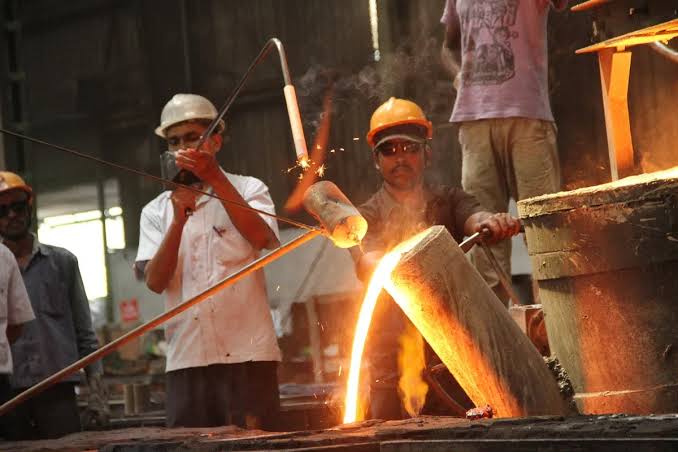
Industrial machinery and equipment often require components with specific dimensions, mechanical properties, shapes, and performance characteristics. Standard casting products may not always meet these requirements, particularly when applications involve unusual operating conditions or complex equipment designs. Custom iron casting solutions address these challenges by allowing manufacturers to develop components according to individual engineering specifications.
Custom casting involves more than producing a component in a particular shape. It requires careful consideration of material selection, mold design, casting methods, machining requirements, and quality standards. Working with an experienced Iron Castings Manufacturer can help industrial businesses develop components that match their equipment requirements while maintaining suitable strength, durability, and dimensional accuracy.
1. What Are Custom Iron Casting Solutions?
<AsyncImage query=”custom industrial iron castings complex metal components foundry” aspectRatio=”16:9″ width=”100%”/>
Custom iron casting solutions refer to manufacturing iron components based on specific customer designs, technical drawings, or application requirements. Unlike standard casting products, these components are developed to meet particular functional and structural needs.
The customization process may involve adjusting several manufacturing factors, including:
- Component dimensions and geometry.
- Iron grade and chemical composition.
- Wall thickness and structural features.
- Mold and core design.
- Surface finish requirements.
- Dimensional tolerances.
- Machining and finishing specifications.
These solutions are useful when equipment manufacturers need components that cannot be easily sourced from standard product catalogs.
2. Why Specialized Industries Need Custom Iron Castings
Different industries use machinery under different operating conditions. Some components must withstand continuous vibration, while others need to support heavy loads, resist wear, or maintain dimensional stability during long operating cycles.
A standard component may not provide the required combination of shape, strength, and functionality.
Custom iron castings allow engineers to develop parts according to the actual demands of the application. This approach can improve equipment compatibility and reduce the need for complicated modifications during assembly.
For specialized industrial applications, customization also helps manufacturers address unique design challenges without relying entirely on fabricated or assembled components.
3. Greater Design Flexibility for Complex Components
<AsyncImage query=”complex geometrical industrial cast iron housing components” aspectRatio=”16:9″ width=”100%”/>
One of the main advantages of custom iron casting is the flexibility it provides during component design. Casting processes can produce shapes that would be difficult, time-consuming, or expensive to create through machining alone.
For example, a custom casting may include internal passages, mounting points, reinforced sections, curved surfaces, and integrated structural features.
This flexibility can help engineers:
- Combine multiple features into a single component.
- Reduce the number of separate parts.
- Create application-specific shapes.
- Incorporate mounting and connection features.
- Optimize component geometry for its intended function.
However, complex designs must still account for metal flow, mold construction, solidification, and the possibility of casting defects. Effective communication between design engineers and foundry specialists is therefore important.
4. Selecting the Right Iron Material for Application Requirements
Material selection is a critical part of custom casting because different iron grades provide different mechanical and physical properties.
The most appropriate material depends on the component’s operating environment, expected loads, wear conditions, and performance requirements.
Common options include:
Gray iron
Gray iron offers good castability, vibration damping, and machinability. It is frequently used for machine bases, housings, engine components, and other industrial parts.
Ductile iron
Ductile iron provides greater tensile strength and ductility than conventional gray iron. Its mechanical properties make it suitable for components exposed to higher loads and impact conditions.
White iron
White iron is known for its hardness and wear resistance. It is used in selected applications where abrasive wear is a major concern, although its brittleness must be considered during design.
Alloy cast iron
Alloying elements can be introduced to modify properties such as wear resistance, strength, or performance under specific operating conditions.
Choosing the correct grade requires evaluating the complete application rather than selecting material based on a single property.
5. Improved Strength and Structural Performance
Custom casting allows component geometry and material specifications to be developed around expected operating loads.
Engineers can identify areas that require additional support, adjust wall thickness, and incorporate reinforcing features where appropriate. These design decisions can help distribute mechanical stresses and reduce unnecessary material use.
For example, industrial machine housings may require sufficient rigidity to support internal mechanisms, while heavy equipment brackets may need to withstand repeated loading.
The final performance of a casting depends on several factors, including material composition, mold design, solidification conditions, heat treatment when required, and inspection procedures.
A properly engineered custom component can provide a more suitable structural solution than a standard part that was designed for a different application.
6. Better Equipment Compatibility and Easier Assembly
Industrial components must fit accurately with surrounding parts. Incorrect dimensions or poorly positioned mounting features can create alignment problems, assembly delays, and additional machining work.
Custom iron casting makes it possible to manufacture components according to specific equipment drawings and assembly requirements.
Important design considerations include:
- Mounting hole locations.
- Connection interfaces.
- Overall dimensions.
- Machining allowances.
- Required clearances.
- Alignment and positioning features.
When these requirements are addressed during the design stage, manufacturers can reduce the need for unnecessary adjustments during assembly.
Machining may still be necessary for precision surfaces, threaded holes, bearing seats, and other features that require tighter tolerances than the casting process can reliably achieve.
7. Cost Efficiency for Specialized Production
Custom iron casting may offer cost advantages when a component has complex geometry or requires repeated production in suitable quantities.
Although custom tooling and mold development involve initial expenses, the ability to produce near-net-shape components can reduce material removal and machining requirements.
Potential cost benefits include:
Reduced material waste: Casting can create shapes closer to the final component geometry, reducing the amount of material removed during machining.
Fewer separate components: Integrated designs may reduce the need for additional fabrication, welding, or assembly.
More efficient production: Suitable casting methods can support repeatable manufacturing once tooling and process parameters are established.
Reduced modification work: Components designed around actual equipment specifications may require fewer adjustments during installation.
The overall economic benefit depends on production volume, component complexity, tooling costs, machining requirements, and inspection needs.
8. Custom Iron Castings for Heavy Machinery
<AsyncImage query=”heavy industrial machinery large cast iron machine base components” aspectRatio=”16:9″ width=”100%”/>
Heavy machinery relies on components that can support substantial loads and maintain structural stability during demanding operating conditions.
Custom iron castings are used in various machine structures and mechanical assemblies, including:
- Machine bases and frames.
- Gearbox housings.
- Pump bodies.
- Bearing housings.
- Industrial brackets.
- Structural support components.
For these applications, manufacturers must consider load distribution, vibration, wall thickness, and the mechanical properties required for long-term operation.
Custom designs can also incorporate features that simplify installation and improve compatibility with other machinery components.
9. Applications in the Automotive and Transportation Industries
The automotive industry requires components with carefully controlled dimensions and material properties. Iron castings are used in selected vehicle systems where strength, rigidity, vibration damping, and thermal characteristics are important.
Depending on the design and application, custom iron components may include:
- Engine-related housings.
- Brake system components.
- Transmission housings.
- Structural brackets.
- Mounting supports.
Transportation equipment manufacturers may also require specialized cast components for machinery, commercial vehicles, and industrial transport systems.
Custom casting enables these parts to be developed according to specific engineering requirements, including installation dimensions and operating conditions.
10. Custom Casting for Agricultural Equipment
<AsyncImage query=”agricultural tractor machinery cast iron transmission housing components” aspectRatio=”16:9″ width=”100%”/>
Agricultural machinery operates in environments where dust, vibration, impact, moisture, and heavy mechanical loads are common.
Equipment such as tractors, harvesters, planting machines, and irrigation systems relies on durable mechanical components.
Custom iron castings can be used for selected gearbox housings, pump bodies, support brackets, and structural parts.
Their design can be adapted to equipment-specific dimensions and mechanical requirements. Material selection is especially important because agricultural components may experience repeated loading and exposure to abrasive environments.
Proper surface protection and maintenance may also be necessary depending on the component’s operating conditions.
11. The Importance of Precision Mold and Core Design
The quality of a custom iron casting begins with the design of its mold and cores. These determine the external shape and, where applicable, the internal cavities of the finished component.
Poor mold design can contribute to defects such as shrinkage, porosity, misruns, and dimensional inconsistencies.
Foundry engineers must consider several factors when developing custom tooling:
- Component geometry and wall thickness.
- Metal flow and gating arrangement.
- Feeding and riser placement.
- Core positioning and stability.
- Solidification and cooling behavior.
- Mold strength and production requirements.
Computer-aided design and casting simulation can help engineers evaluate metal flow and solidification before manufacturing begins. This may reduce trial-and-error work and support more reliable production planning.
12. Quality Control in Custom Iron Casting Production
<AsyncImage query=”industrial iron casting quality inspection dimensional measuring equipment foundry” aspectRatio=”16:9″ width=”100%”/>
Custom components often have specific acceptance criteria. Quality control must therefore be planned around the technical requirements of each product.
Inspection may cover raw materials, chemical composition, casting dimensions, surface condition, mechanical properties, and internal soundness.
Common quality control methods include:
- Visual inspection for surface defects.
- Dimensional measurement using precision instruments.
- Hardness testing.
- Tensile testing where required.
- Ultrasonic examination.
- Radiographic testing for suitable components.
- Metallurgical analysis.
The inspection method should be selected according to the component’s function and applicable technical specifications.
Maintaining accurate production and inspection records also helps manufacturers trace potential issues and improve consistency across repeated orders.
13. How Machining Completes Custom Iron Castings
Casting produces the basic component shape, but some applications require additional machining to achieve the necessary dimensional accuracy and surface finish.
Common machining operations include milling, drilling, boring, turning, tapping, and grinding.
These processes are especially important for features such as bearing seats, sealing surfaces, threaded connections, and precision mounting interfaces.
Machining allowances must be considered during casting design. If insufficient material is provided, a component may not achieve its required final dimensions. Excessive allowances, on the other hand, can increase machining time and material waste.
Coordinating casting and machining requirements from the beginning helps create a more efficient manufacturing process.
14. Factors to Consider When Ordering Custom Iron Castings
Businesses planning to purchase custom cast components should prepare clear technical information before starting production discussions.
Important considerations include:
Technical drawings: Provide accurate dimensions, tolerances, and design details.
Material specifications: Identify the required iron grade and relevant mechanical properties.
Operating conditions: Explain expected loads, temperatures, vibration, wear, and environmental exposure.
Production quantity: Share estimated order volumes and expected future demand.
Machining requirements: Identify surfaces and features that require additional precision.
Inspection standards: Define testing methods and acceptance criteria.
Delivery expectations: Discuss tooling development, sample approval, production scheduling, and packaging.
Clear specifications help reduce misunderstandings and allow manufacturers to evaluate the feasibility of the project more accurately.
15. The Role of Communication Between Customers and Manufacturers
Successful custom casting projects depend on cooperation between the customer and the foundry. Engineers, purchasing teams, and production specialists should exchange technical information throughout the development process.
Customers should communicate the component’s intended function and operating conditions rather than providing dimensions alone. This additional information can help foundry engineers identify potential design improvements and manufacturing risks.
Manufacturers can contribute by reviewing drawings, recommending suitable materials, evaluating casting methods, and identifying features that may require design adjustments.
Sample production and approval can also be useful before moving into larger manufacturing quantities, particularly when components have complex geometry or demanding performance requirements.
Conclusion
Custom iron casting solutions provide industrial businesses with greater flexibility when standard components cannot meet specific engineering and operational requirements. They support complex geometries, application-specific material selection, improved equipment compatibility, and more efficient component production.
From heavy machinery and automotive equipment to agricultural systems and specialized industrial assemblies, custom castings can address a wide range of manufacturing challenges. Their success depends on careful design, appropriate material selection, effective mold engineering, precise machining, and reliable quality control.
By evaluating these factors early and maintaining clear communication throughout production, businesses can obtain iron casting components that meet their technical specifications and support dependable equipment performance.