


Water distribution and plumbing systems rely on controlled flow to operate safely and efficiently. In many installations, water must travel in a specific direction to supply equipment, maintain pressure, and support normal system operation. However, pressure changes, pump shutdowns, and differences in water levels can cause flow to reverse. This unwanted movement, known as backflow, can damage equipment and affect water quality.
A One Way Water Valve helps prevent this problem by allowing water to pass in the intended direction while restricting reverse flow. These valves operate automatically in response to changing pressure conditions, reducing the need for manual intervention. They are commonly used in water supply networks, pumping systems, industrial pipelines, and other applications where maintaining directional flow is essential.
What Is a One Way Water Valve?
A one-way water valve is a mechanical device designed to permit flow in one direction and prevent it from returning through the pipeline. It is commonly known as a check valve or non-return valve.
Unlike manually operated isolation valves, a check valve generally does not require a handwheel or operator to control its opening and closing. Instead, the pressure and flow conditions within the pipeline determine its position.
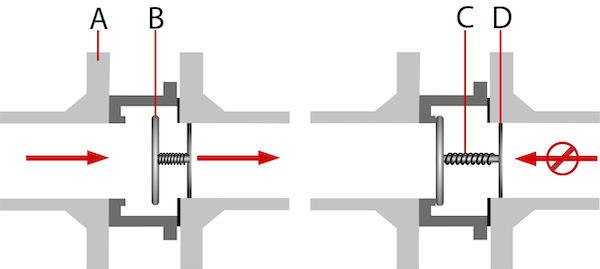
When upstream pressure is sufficient, the internal closing mechanism moves away from the seat, allowing water to pass. If the flow slows, stops, or attempts to reverse, the mechanism returns toward the seat and restricts reverse movement.
The valve’s automatic operation makes it useful in systems that require continuous protection against backflow.
Why Is Backflow Prevention Important?
Backflow occurs when water moves in the opposite direction from its intended path. Although it may seem like a minor change in flow direction, it can create several operational and safety concerns.
Protecting Water Quality
In certain plumbing and water distribution arrangements, reverse flow can introduce contaminated water into a clean supply line. This may occur when pressure changes allow water from storage tanks, industrial equipment, or other connected systems to move backward.
Check valves can help limit this risk, although they should not automatically be treated as a complete substitute for approved backflow prevention assemblies where regulations require them.
Protecting Pumps and Equipment
When a pump stops operating, water in the discharge pipeline may flow backward. This reverse movement can cause unwanted pump rotation, pressure disturbances, or additional mechanical stress.
A properly selected check valve helps reduce these risks by limiting reverse flow.
Maintaining System Pressure
Backflow can cause pressure loss in systems that depend on a stable supply. By restricting reverse movement, a check valve helps maintain the intended flow arrangement and supports consistent system operation.
Reducing Operational Disruptions
Uncontrolled reverse flow can interfere with connected equipment and affect normal processes. Automatic flow-direction control helps reduce the need for frequent manual intervention.
How Does a One Way Water Valve Work?
The operating principle of a check valve is relatively simple. It responds to pressure differences across the valve rather than relying on an external control mechanism.
Forward Flow Opens the Valve
When water enters from the designated inlet, upstream pressure acts on the internal disc, flap, ball, or other closing element. Once the pressure is sufficient to overcome the closing force, the mechanism moves away from its seat.
Water can then pass through the valve and continue along the pipeline.
Reverse Flow Closes the Valve
When downstream pressure becomes greater than upstream pressure, or forward flow stops, the closing mechanism moves back toward the seat. This action restricts water from traveling in the opposite direction.
The speed and effectiveness of closure depend on the valve design, operating conditions, and pressure changes within the system.
Automatic Operation
Most check valves operate without electrical power or manual control. This makes them useful in pumping systems and other installations where automatic response to changing flow conditions is preferred.
However, the valve must be installed in the correct orientation and selected according to the system’s pressure and flow requirements.
Common Types of One Way Water Valves
Different check valve designs use different internal mechanisms. The right option depends on pipeline size, flow conditions, installation position, and the level of reverse-flow protection required.
Swing Check Valves
<AsyncImage query=”industrial flanged swing check valve water pipeline” aspectRatio=”16:9″ width=”100%”/>
Swing check valves use a hinged disc that moves away from the seat when water flows forward. When flow slows or reverses, the disc swings back toward the closed position.
These valves are commonly used in larger water pipelines where flow conditions are suitable for their operation. Their performance can be affected by installation orientation and sudden pressure changes.
Lift Check Valves
<AsyncImage query=”industrial lift check valve stainless steel flanged” aspectRatio=”16:9″ width=”100%”/>
Lift check valves contain a disc or piston that moves vertically within the valve body. Forward pressure lifts the closing element, while reverse pressure moves it back onto the seat.
They are often considered for applications requiring a compact internal closing mechanism and reliable seating under suitable operating conditions.
Spring-Loaded Check Valves
<AsyncImage query=”spring loaded stainless steel water check valve” aspectRatio=”16:9″ width=”100%”/>
Spring-loaded check valves use a spring to assist the closing action. When forward pressure exceeds the valve’s cracking pressure, the internal mechanism opens. When pressure decreases, the spring helps return the closing element to its seat.
These designs can be useful where installation space is limited or faster closure is required.
Ball Check Valves
<AsyncImage query=”industrial ball check valve water pump” aspectRatio=”16:9″ width=”100%”/>
Ball check valves use a movable ball as the closing element. Forward flow moves the ball away from the seat, while reverse flow pushes it back to block the passage.
They are used in selected water, wastewater, and pumping applications. The ball and body materials must be appropriate for the fluid and operating environment.
Main Applications of One Way Water Valves
Check valves are used across a wide range of systems because many installations depend on maintaining a single direction of flow.
Water Pumping Systems
One-way valves are commonly installed on pump discharge lines to reduce reverse flow when the pump stops. This helps protect pumping equipment and supports more stable system operation.
The valve must be selected to suit the pump’s flow rate, pressure, and operating characteristics.
Residential Plumbing
In residential plumbing arrangements, check valves can help prevent unwanted reverse movement in selected supply lines and equipment connections. Their use depends on the plumbing design and applicable local regulations.
Municipal Water Distribution
Water distribution networks use check valves in suitable locations to manage flow direction and protect connected equipment. They may be installed near pumps, storage systems, and other pipeline components.
Industrial Processing
Industrial facilities often use water for cooling, cleaning, production, and equipment operation. Check valves help prevent reverse flow in pipeline sections where directional control is important.
Irrigation Systems
Agricultural irrigation networks may use check valves to prevent water from draining backward through pumps and supply lines. The correct design depends on the system layout, water quality, and operating pressure.
Water Treatment Facilities
Treatment plants use check valves in various process lines to maintain intended flow direction and protect pumps and other equipment. Material compatibility is especially important where treated water or process chemicals are involved.
Key Benefits of Installing a One Way Water Valve
A correctly specified check valve offers several practical benefits for water systems.
- Automatic operation: The valve responds to pressure and flow changes without requiring routine manual control.
- Backflow reduction: It restricts reverse water movement and helps protect connected pipeline sections.
- Equipment protection: It can reduce the risk of reverse rotation and pressure-related problems in pumping systems.
- Improved flow management: It supports the intended direction of water movement throughout the installation.
- Reduced operating effort: Automatic opening and closing limit the need for manual intervention.
- Installation flexibility: Different designs and connection types accommodate a range of pipeline configurations.
These benefits depend on proper sizing, installation, maintenance, and compatibility with actual operating conditions.
How to Choose the Right One Way Water Valve
Selecting a suitable check valve requires evaluating the entire water system rather than focusing on pipeline diameter alone.
1. Determine the Required Flow Rate
The valve must accommodate the expected flow rate without creating excessive pressure loss. An undersized valve may restrict flow, while an oversized design may not operate reliably under low-flow conditions.
2. Check the Operating Pressure
Review the normal working pressure as well as possible pressure fluctuations and surge conditions. The valve’s pressure rating must be suitable for the system.
3. Understand the Installation Position
Some check valve designs are intended for specific mounting orientations. Confirm whether the selected model can be installed horizontally, vertically, or in both positions according to the manufacturer’s instructions.
4. Consider the Fluid Characteristics
Water may contain suspended particles, sediment, or treatment chemicals. The internal mechanism and body materials should be compatible with the water quality and operating environment.
5. Select Suitable Body Materials
Common valve materials include cast iron, ductile iron, stainless steel, and other alloys. Material selection should account for corrosion exposure, pressure requirements, temperature, and expected service conditions.
6. Evaluate Cracking Pressure
Cracking pressure is the minimum upstream pressure difference required to begin opening a check valve. The selected value should be compatible with the available system pressure and pump performance.
7. Consider Water Hammer Risk
Rapid valve closure can contribute to pressure surges known as water hammer. Where sudden flow reversal or pump shutdown is possible, engineers should evaluate closure characteristics and the need for additional surge-control measures.
8. Verify Connection Compatibility
Check the valve’s nominal size, flange dimensions, pressure class, or threaded connection requirements. Correct compatibility helps ensure secure installation and reduces the risk of leakage.
9. Review Standards and Testing Requirements
Depending on the application, valves may need to meet specific dimensional, pressure-testing, material, or water industry standards. Confirm the requirements relevant to the project and installation location.
Installation Best Practices
Proper installation is essential for reliable check valve performance. Before installation, inspect the valve for visible damage and confirm that its size, pressure rating, and connection type match the pipeline design.
The following practices can help support correct operation:
- Follow the flow-direction arrow marked on the valve body.
- Install the valve in an orientation approved by the manufacturer.
- Clean the pipeline to remove debris that could interfere with the closing mechanism.
- Align connecting pipes correctly to avoid unnecessary mechanical stress.
- Use suitable gaskets, fasteners, and sealing materials.
- Provide adequate support for heavy valves and adjoining pipework.
- Confirm that sufficient access is available for future inspection and maintenance.
After installation, the system should be tested under controlled conditions to confirm that the valve opens during forward flow and closes when reverse pressure develops.
Maintenance and Common Problems
Although check valves operate automatically, they still require periodic inspection. Sediment buildup, worn seating surfaces, corrosion, and damaged internal components can affect performance.
Common warning signs include:
- Reverse leakage when the valve should be closed.
- Unusual noise or vibration during operation.
- Restricted forward flow.
- Repeated water hammer or pressure fluctuations.
- Sticking or delayed movement of the internal closing element.
Maintenance procedures may include checking external connections, inspecting internal parts, cleaning deposits, and replacing worn seals or components. The pipeline must be safely isolated and depressurized before maintenance begins.
The inspection frequency should reflect operating conditions, water quality, manufacturer recommendations, and the importance of the installation.
One Way Water Valves vs. Other Valve Types
A check valve serves a different purpose from manually operated isolation and flow-control valves.
| Valve Type | Primary Function | Typical Operation |
|---|---|---|
| Check valve | Prevents reverse flow | Automatic |
| Gate valve | Isolates a pipeline | Manual or actuated |
| Ball valve | Opens or closes a flow passage | Quarter-turn |
| Globe valve | Regulates flow | Manual or actuated |
| Butterfly valve | Provides isolation or selected flow control | Quarter-turn |
A check valve does not normally provide the same isolation function as a gate or ball valve. For this reason, pipeline systems may require both check valves and separate isolation valves to support safe operation and maintenance.
Conclusion
One-way water valves play an important role in protecting pipeline systems from unwanted reverse flow. By responding automatically to pressure differences, they help maintain the intended direction of water movement and reduce potential problems involving pumps, connected equipment, and water distribution networks.
Choosing the right valve involves considering flow rate, pressure, cracking pressure, material compatibility, installation orientation, and closure characteristics. With appropriate selection, correct installation, and regular maintenance, check valves can contribute to efficient and dependable water system performance.