


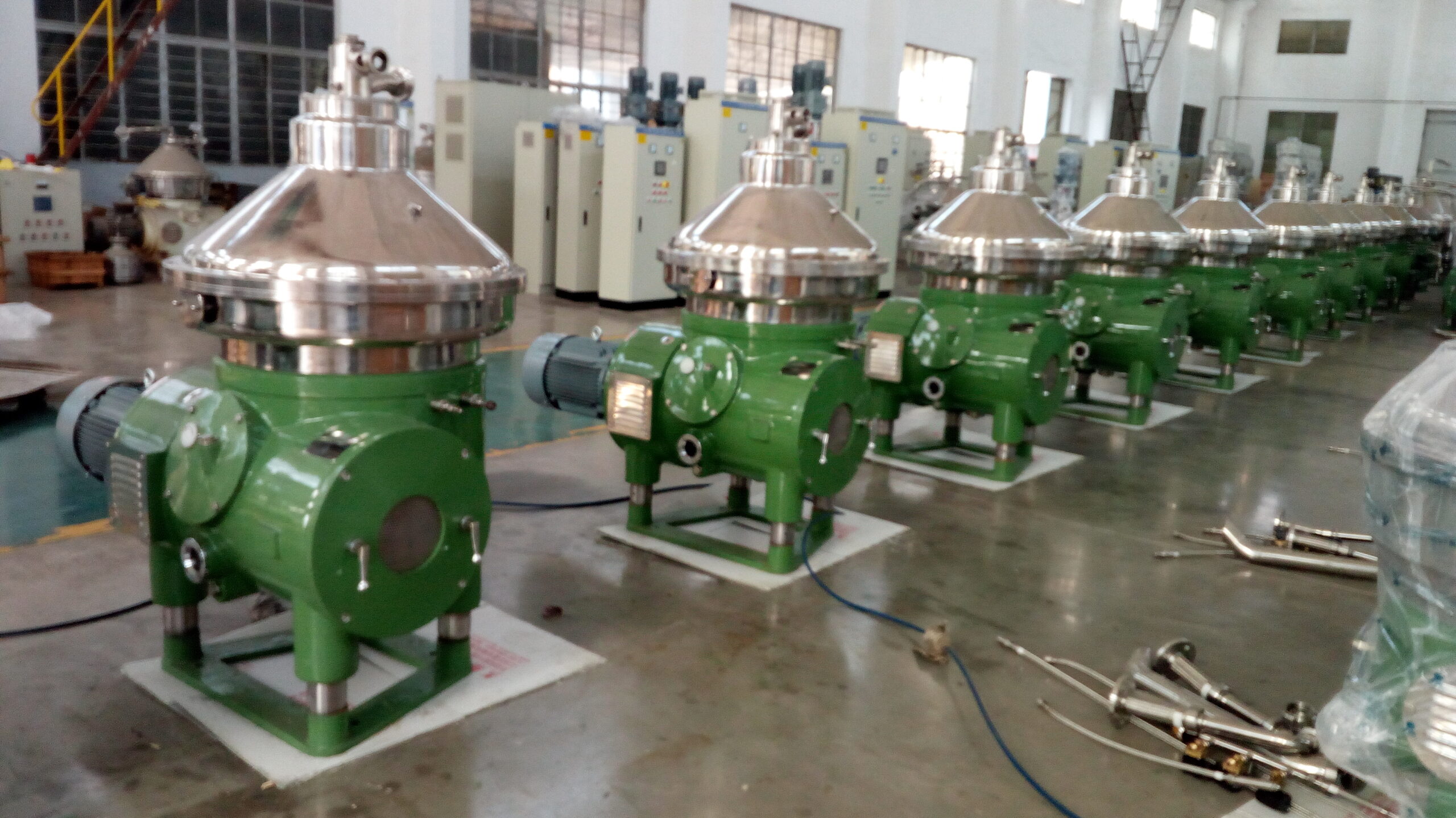
Many industrial processes require separation to happen quickly without sacrificing the quality of the final product. When fine solids or multiple liquid phases need to be separated continuously, high-speed centrifugal equipment can provide a more efficient alternative to gravity-based methods.
A Disc Centrifuge uses rapid rotation to generate centrifugal force that is far greater than ordinary gravity. This force accelerates the movement of components with different densities, allowing suspended particles and liquid phases to separate within a relatively compact processing system.
What Makes High-Speed Separation Different?
Traditional settling relies primarily on gravity. Fine particles may take a considerable amount of time to settle, particularly when they are small, lightweight, or close in density to the surrounding liquid.
A high-speed centrifuge creates a much stronger separation force. As the bowl rotates, denser components migrate outward while lighter components move toward the center of the rotating chamber.
This accelerated process makes centrifugal separation suitable for applications where conventional settling would require excessive time or space.
The Role of the Rotating Bowl
The rotating bowl is the main chamber where centrifugal separation occurs. Its high rotational speed generates the force needed to move particles and liquid phases according to their densities.
The bowl must be carefully balanced because even small amounts of uneven material accumulation can affect mechanical stability at high speed.
For this reason, bowl condition, cleanliness, and operating speed are important considerations in maintaining reliable performance.
How the Disc Stack Improves Separation
One of the defining features of a disc centrifuge is the internal stack of closely spaced conical discs.
The discs divide the liquid into thin layers, reducing the distance suspended particles need to travel before reaching a surface. Once particles reach the discs, they can move toward the outer region of the bowl.
This arrangement provides a large effective separation area without requiring an extremely large bowl. It is particularly useful when processing liquids containing fine suspended solids.
The High-Speed Separation Process
The separation cycle can be summarized in several stages.
Feed Introduction
The process begins when the mixture enters the rotating bowl. Internal components distribute the material into the separation area.
Centrifugal Migration
As the bowl rotates, dense solids and heavier liquid phases move outward. Lighter liquid components move closer to the rotational axis.
Fine-Particle Collection
Suspended particles encounter the disc surfaces and migrate along the inclined discs toward the outer collection region.
Liquid Separation
Clarified liquid or separated liquid phases move toward their respective outlets. The configuration depends on whether the primary goal is liquid-solid clarification or liquid-liquid separation.
Solids Removal
Accumulated solids are removed according to the equipment’s discharge arrangement. Continuous or periodic discharge can be used depending on the solids load and machine design.
Applications of High-Speed Disc Centrifugation
High-speed centrifugal separation is used in a broad range of processing industries.
Food and Beverage
Food and beverage producers use centrifugal separation for applications such as milk clarification, beverage clarification, and edible oil processing.
The technology can help remove fine suspended material while maintaining a continuous processing flow.
Chemical Processing
Chemical plants may use centrifuges to clarify process liquids, recover catalysts, or separate immiscible liquid phases.
Because chemical mixtures can vary widely in viscosity and composition, equipment settings must be matched carefully to the material.
Pharmaceutical and Biotechnology
High-speed separation can be useful in pharmaceutical and biotechnology processes involving fermentation liquids, biological materials, and fine suspended particles.
These applications often place additional importance on hygienic design, controlled processing conditions, and cleaning procedures.
Oil and Fuel Processing
Oil-based applications can involve water and fine solid contaminants. Centrifugal equipment can separate these unwanted components and help maintain fluid cleanliness.
The actual separation result depends on the density difference, viscosity, temperature, and contaminant concentration.
Wastewater Treatment
Industrial wastewater may contain suspended solids and other materials that are difficult to remove through simple settling.
A high-speed centrifuge can provide an additional separation stage or form part of a larger treatment system, depending on the characteristics of the wastewater.
Factors That Affect Separation Speed
Although high rotational speed is central to centrifugal separation, several other variables determine how quickly and effectively a mixture separates.
Important factors include:
- Particle size
- Density difference
- Liquid viscosity
- Feed rate
- Solids concentration
- Temperature
- Bowl speed
- Disc stack configuration
For example, very fine particles may require more favorable conditions than larger particles, while highly viscous liquids can slow particle movement.
Why Feed Rate Matters
Increasing feed rate can increase production throughput, but it may also reduce the effective separation time available inside the equipment.
If the flow becomes too high, fine particles may not have sufficient opportunity to migrate toward the disc surfaces or bowl wall.
Therefore, the ideal operating point is usually a balance between processing capacity and the required separation quality rather than simply the highest possible flow rate.
Importance of Proper Maintenance
High-speed rotating machinery requires regular maintenance. Deposits inside the bowl can create imbalance, while worn bearings, seals, or other components may affect reliability.
Routine cleaning, vibration monitoring, component inspection, and appropriate lubrication where required can help maintain stable operation.
Maintenance procedures should always follow the specific equipment manufacturer’s instructions and applicable safety requirements.
Selecting Equipment for High-Speed Separation
Equipment selection should begin with the characteristics of the material to be processed. Engineers should evaluate the required throughput, particle size, solids concentration, liquid properties, desired separation quality, and operating temperature.
It is also important to consider how solids will be discharged and how the centrifuge will integrate with upstream and downstream equipment.
Shenzhou Machinery is one manufacturer associated with centrifugal separation equipment, but the appropriate machine configuration should be determined according to the specific application and technical requirements.
Conclusion
Disc centrifuges achieve high-speed separation by combining rapid bowl rotation with an internal disc stack. The resulting centrifugal force accelerates the movement of dense solids and liquid phases, while the closely spaced discs provide an efficient environment for fine-particle separation.
Their ability to operate continuously makes them useful across food processing, chemical production, biotechnology, oil treatment, wastewater processing, and other industries.
Ultimately, successful high-speed separation depends on more than rotational speed. Feed properties, flow rate, disc configuration, solids handling, and maintenance all contribute to achieving consistent and efficient results.