


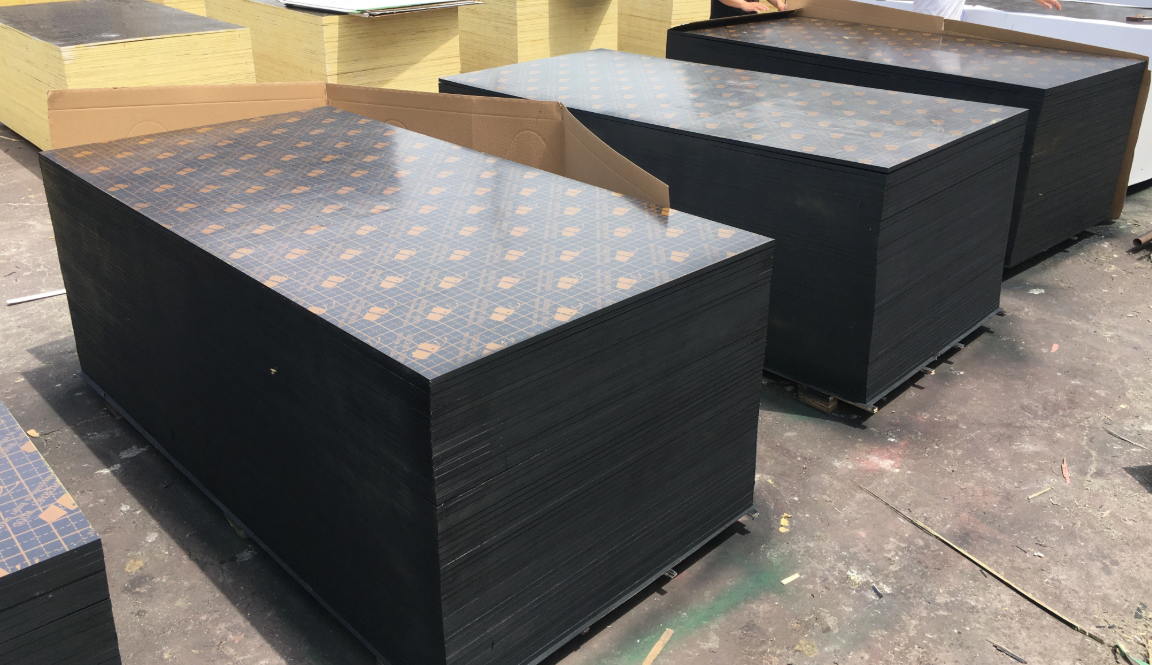
A seasoned procurement officer once shared a hard-won piece of advice: “If you buy cheap panels, you’ll buy them twice.” It sounds simplistic, yet countless project budgets have been blown by overlooking this truth.
Consider this scenario. Two quotes land on your desk for wholesale film faced plywood. Quote A is $28 per sheet. Quote B is $42 per sheet. If you are like most buyers, your instinct is to lean toward Quote A to save the project budget. But here is the trap: Price is not cost. By focusing solely on the initial invoice, you could end up paying nearly double the total material cost by the time the concrete is poured.
This article will dismantle the pricing illusion in the concrete formwork plywood market and equip you with a smarter financial metric: Cost Per Use (CPU) .
The 8 vs. 20 Reuse Cycle Dilemma
Let’s return to those two quotes. Why is one panel significantly more expensive?
Panel A ($28): A budget-oriented option, usually featuring a 120g/m² film and a lower-density core. The supplier promises 8 reuses.
Panel B ($42): A premium film faced plywood 18mm / 1220x2440mm, featuring high-density hardwood core and a 220g/m² phenolic film. The supplier guarantees 20 reuses.
If you buy 100 sheets of Panel A to cover your slab area, you will need to purchase two and a half rounds of panels to complete 20 pours. If you buy Panel B, you need only one round.
Here is the financial reality check:
| Metric | Panel A (Budget) | Panel B (Premium) |
|---|---|---|
| Price Per Sheet | $28 | $42 |
| Expected Reuse Cycles | 8 times | 20 times |
| Cost Per Use (CPU) | $3.50 | $2.10 |
| Total Cost for 20 Pours (100-sheet deck) | $28 × 250 sheets = $7,000 | $42 × 100 sheets = $4,200 |
The result: By spending 50% more upfront, you actually reduce your total material cost by 40%. This is the logic that separates savvy procurement managers from the rest.
The “Invisible” Costs of Cheap Concrete Formwork Plywood
Why do cheap panels end up being so expensive? The answer lies in the hidden costs that never appear on the invoice. When you choose a low-quality film faced plywood supplier, you are often signing up for these four financial leaks:
1. Labor Inefficiency
Cheap film surfaces lead to concrete adhesion. Workers spend hours chipping and scraping the plywood to release it from the slab, increasing man-hour costs by 15-20%.
2. Schedule Delays
When panels delaminate or warp prematurely, the pour stops. You lose valuable construction days waiting for replacements.
3. Surface Remediation
Low-quality concrete formwork plywood often results in honeycombing or uneven surfaces. The cost of patching, grinding, and making good on these defects often exceeds the price of the panels themselves.
4. Safety Risks
The most severe risk. A blowout due to structural failure of the plywood can lead to injuries, equipment damage, and significant liability claims.
How to Verify Supplier Reuse Claims
In the wholesale film faced plywood industry, not all promises are created equal. If a film faced plywood manufacturer claims 20+ reuses, they must be able to prove it. Here is how to push back during negotiations:
1. Request Field References
Ask for a list of projects where the same film faced plywood 18mm specification achieved the claimed cycle count.
2. Scrutinize Test Reports
Don’t accept in-house “Certificates of Conformity.” Insist on third-party SGS/Intertek reports showing:
Impregnation Peel Test: Minimum 72 hours boiling without delamination.
Surface Abrasion: Wear resistance of the phenolic film.
3. Contractual Guarantees
Do not accept vague language like “up to 25 uses.” Insert a clause: “If the panels fail to achieve [X] reuses under standard usage, the supplier shall provide a proportional refund or replacement.” Reliable suppliers will honor this.
Strategic Sourcing: Matching Product to Project Scale
How much panel should you invest in? It depends on the volume of your project. Here is a decision-making framework:
| Project Size | Recommended Strategy | Rationale |
|---|---|---|
| Small (<500 sheets) | Mid-range panels | The ROI on premium panels may not be fully realized with limited reuses. |
| Medium (500-2,000 sheets) | Premium grade | You will hit the break-even point (around 8-9 pours) and save money on the backend. |
| Large (>2,000 sheets) | Premium + Long-term Agreement | Lock in pricing and secure priority production capacity. |
The Solution to the “Cost Per Use” Equation
To successfully implement this strategy, you need a film faced plywood supplier that doesn’t just compete on price but on total value.
This is where Fortuna differentiates itself. Rather than chasing the lowest price tag, Fortuna engineers its concrete formwork plywood specifically to maximize the “Denominator” (Reuse Cycles) in the CPU equation.
Choosing Fortuna means choosing a film faced plywood supplier that guarantees film faced plywood 18mm / 1220x2440mm products engineered to deliver 20+ reuses, effectively slashing your Cost Per Use.
A Legacy of Quality Since 1993
Fortuna is not a new player in the concrete formwork plywood arena. Since 1993, the company has been deeply rooted in the research, development, and production of high-performance wood panels. This 30-year journey has transformed them into a benchmark for reliability among international procurement managers.
Unmatched Scale and Global Reach
Operating from a 208,000m² factory base in Linyi, China—the world’s largest plywood production hub—Fortuna leverages industrial-scale efficiency to maintain consistent quality.
Annual Capacity: 300,000m³ (Shipping over 100 containers monthly)
Global Footprint: Exporting to 170+ countries, proving their products perform reliably across diverse climates, from the humid tropics to arid desert conditions
The Power of International Certifications
For a B2B buyer, certifications are non-negotiable safeguards. Fortuna holds a comprehensive suite of international accreditations that set them apart from the average film faced plywood manufacturer:
FSC (Forest Stewardship Council): Guarantees legally sourced, sustainable timber
CE Marking: Compliance with European health, safety, and environmental protection standards
CARB Phase 2: Meets the stringent California Air Resources Board limits for formaldehyde emissions, ensuring safety for workers
ISO 9001: Certified quality management systems that ensure every batch of wholesale film faced plywood meets the same rigorous standards
Premium Materials for Maximum Lifecycle
Understanding that Cost Per Use is the ultimate metric for smart buyers, Fortuna offers premium material upgrades that extend the life of their concrete formwork plywood:
Dynea Film: A premium-grade Finnish phenolic overlay that significantly boosts surface wear resistance and enables 25–40+ reuse cycles
Anti-Slip Solutions: An optional surface texture treatment that enhances worker safety on scaffolding and formwork decks—a critical feature for high-stakes infrastructure projects
Proven on the World’s Most Demanding Stages
The ultimate test of a film faced plywood supplier is the quality of projects they help bring to life. Fortuna‘s concrete formwork plywood has been trusted on some of the most iconic engineering marvels globally:
Beijing National Stadium (Bird’s Nest) – China
Hamad International Airport – Doha, Qatar
Shanghai Pudong International Airport – China
Burj Khalifa – Dubai, UAE
When your formwork material is used to shape the world’s tallest building or a critical international transport hub, it carries a level of assurance that no sales pitch can match.
By combining scale, elite certification, and real-world validation on landmark projects, Fortuna stands as a film faced plywood manufacturer that not only talks about quality but delivers it—project after project, pour after pour.
FAQs – Questions Every Buyer Should Ask Before Signing
Q1: How long does 18mm film faced plywood actually last?
A: It varies wildly by quality. Budget film faced plywood 18mm with 120g film lasts 5-8 reuses. Premium concrete formwork plywood with 220g+ Dynea phenolic film lasts 20-25+ reuses.
Q2: What causes the most damage to formwork plywood?
A: Unsealed cut edges. When you cut a panel, moisture penetrates the core, leading to swelling and delamination. Always ask if the supplier provides edge-sealing paint or requires you to do it on-site.
Q3: How can I tell if a supplier is a factory or just a trader?
A: The best film faced plywood supplier will allow a video conference walkthrough of the production line. Check if they have hot presses and veneer drying lines—traders rarely have these.
Q4: What are the red flags in a supplier’s proposal?
A: Vague promises (“high quality” without specifications), inability to provide third-party test reports, and resistance to placing performance guarantees in the contract.
Q5: Does higher density always mean better performance?
A: Generally, yes. Concrete formwork plywood with a core density of 600-750kg/m³ (often eucalyptus/hardwood) resists compression and deformation far better than poplar (around 450kg/m³).
Q6: Should I buy based on CIF or FOB price?
A: Focus on Cost Per Use, not just FOB or CIF. However, choose a film faced plywood manufacturer with strong export logistics (like Fortuna) to ensure the shipping quality doesn’t compromise the panel lifecycle.
Conclusion
Stop buying wholesale film faced plywood based on the price tag. Start buying it based on the Cost Per Use. In the world of construction finance, a $42 panel that lasts 20 pours is significantly cheaper than a $28 panel that fails after 8.
As you plan your next procurement cycle, look beyond the quote. Look for the film faced plywood manufacturer with the certifications, the scale, and the track record to deliver on their promises. Fortuna fits this criterion.
Ready to stop paying twice for your formwork? Contact Fortuna today to discuss your project scope and receive a free Cost-Per-Use analysis and samples of our premium concrete formwork plywood range.