


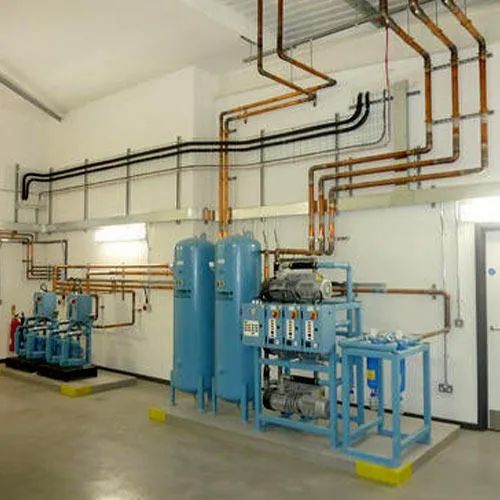
Pinpoint accuracy and safety are essential in today’s healthcare environment. Whether it’s in ICU beds or modular operation theatres, the continuous flow of medical gases can have a direct effect on patient recovery. An effective medical gas pipeline system is more than an engineering project — it’s a life-saving line. As the hospitals in India are aligning their infrastructure with NABH Standards of Medical Gas Pipeline Systems, safety , compliance and operational efficiency has reached new standards.
Medical Gas Pipeline System What You Need to Know about NABH Compliance!
A medical gas pipeline is a system consisting of interconnected and interrelated piping that is used for the distribution of anaesthetic gases, medical gases, evaporated anaesthesia, suction, and oxygen throughout a healthcare facility. Instead of employing a separate cylinder in each room, Gas is utilised centrally into different outlets by means of regulated piping.
A medical gas pipeline system is comprised of the following elements:
From the central source of gas (oxygen bank or liquid oxygen tank)
- – Pressure regulators
- – Copper pipelines
- – Zone valve boxes
- – Alarm systems
- – Terminal units and outlets
- – Vacuum systems
An efficient MGPS delivers gases to the patient with no interruption in flow of gas, at the correct pressure and without contamination. There is no room for any compromise in design or maintenance with such clinical risks at stake.
Significance of NABH Standards in Medical Gas Pipeline Systems
NABH (National Accreditation Board for Hospitals & Healthcare Providers) is the apex body for establishing and operating accreditation programme for healthcare organizations in India. NABH has laid down strict guidelines for its compliance that need to be observed in medical gas infrastructure so that systems are safe and reliable for use while being well maintained.
Complying with NABH Standards for MGP Systems ensures:
Patient Safety Assurance
Pressure testing, purity checking and alarm test are the strict testing procedures currently required by NABH. This reduces the risk from gas contamination, leakage or not precise pressure delivery.
Standardized Installation Practices
The use of high quality copper pipe, correct brazing and a gasoline clearly labeled to eliminate cross connections are issues taken up by standards. It helps to minimize human mistakes and mounting incorrectness.
Regular Maintenance and Audits
Periodic inspection and documentation are to be carried out in hospitals. Scheduled preventive plans are also a requirement, helping us to maintain the system properly.
Alarm and Monitoring Systems
NABH has stipulated that functional master alarms, area alarms and local alarms be provided for instant detection of pressure changes or loss in supplies.
Emergency Preparedness
Backup utilities such as secondary manifolds or drag rescue equipment should also be available for use during failure of the supplier systems or in case of power failure.
Core NABH Compliance Requirements
- Hospitals seeking accreditation need to ensure that their medical gas pipeline system meets specific structural and operational criteria:
- – Separation of gas and vacuum lines where necessary
- – As per standard color coding and Labels.
- – Leak-proof installation
- – Individual select shutting off valves for different zones
- – Documented validation before commissioning
- – Regular third-party testing and certification
Compliance is not just putting it in - compliance also means that you’re managing the entire end system over time.
Design Considerations for NABH-Compliant MGPS
In order to plan for a medical gas pipeline system covering NABH requirements, healthcare facility planners should concentrate on:
Capacity Planning
Peak loads, particularly for critical areas like ICUs, emergency rooms and OTs should be supported by the system.
Future Expansion
The design of the pipeline should be such that the scalability can happen without causing any disruption to activities in progress.
Infection Control
The design, material and installation shall be such as to eliminate risks of contamination.
Integration with Modular OTs
Modular operation theatres of today demand accuracy in pressure control and easy interface with MGPS.
Advantages of NABH Complaint Medical Gas Pipeline Systems
Enhanced Hospital Credibility
One, the NABH accreditation enhances the brand of a hospital and in turn offers confidence to patients and investors on the quality front.
Reduced Risk of Legal Issues
A good compliance will reduce the operational carelessness and prevent medico-legal complications.
Operational Efficiency
The use of centralized gas servicing enhances supervision and minimizes manual swapping over to cylinder.
Cost Optimization
While the initial cost may be higher, preventive maintenance and less leakage contribute to long-term savings.
Common Challenges in Implementation
Although vital, numerous health facilities have encountered the following:
- – Outdated infrastructure in older hospitals
- – Lack of trained maintenance staff
- – Improper documentation practices
- – Inadequate alarm monitoring
Working with experienced MGPS fabricators and compliance experts can be a successful way directed to overcoming these barriers.
The Future of Medical Gas Piping Systems
As the demand and focus on quality of healthcare, patient safety, care accessibility and cost cutting come front and center for health organizations, compliance is not a choice—it’s a must. The COVID-19 pandemic focused attention on the importance of oxygen supply systems and spurred hospitals to modernize and standardize their medical gas infrastructure.
Automation, real-time monitoring and digital alarm systems will help in enhancing adherence to NABH Standards for the Medical Gas Pipeline System in the years ahead. Institutions that invest proactively in compliant infrastructure will continue to lead the way on accreditation and patient confidence.
Conclusion
A medical gas pipeline system is one of the most essential considerations in any healthcare institution. And harmonizing it with NABH Standards for Medical Gas Pipeline Systems is not a check listing — rather, it’s an indication to patient safety, system performance and organization integrity.
Each phase, all the way from creation and validation to maintenance and monitoring, must be precise and comply with existing methodologies. NABH compliance focused hospitals are safer, more reputable and comprising of hospitals providing better healthcare in the long term.