


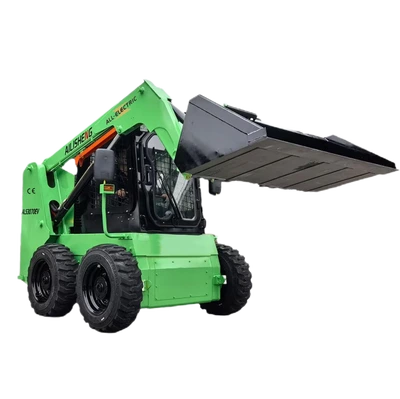
Battery capacity and operating runtime are important considerations when choosing electric construction equipment. Contractors and equipment operators need to understand how long a machine can work on a single charge, how operating conditions affect energy consumption, and what steps can help maintain consistent performance. These factors influence daily productivity, charging schedules, and the overall cost of equipment ownership.
An Electric Skid Loader uses rechargeable battery power to operate its drive system and, depending on its design, hydraulic functions. Unlike diesel-powered equipment, its working time depends partly on the energy stored in the battery and how quickly the machine consumes that energy during operation. Understanding battery capacity, workload, terrain, temperature, and charging requirements helps businesses make informed decisions and plan equipment use more effectively.
What Is Electric Skid Loader Battery Capacity?
Battery capacity describes how much energy a battery can store. For electric skid loaders, it is commonly expressed in kilowatt-hours (kWh). A higher capacity generally allows a machine to store more energy, although actual runtime also depends on the equipment’s efficiency and workload.
Battery capacity should not be confused with motor power. Capacity relates to stored energy, while power, measured in kilowatts (kW), indicates how quickly energy can be delivered or consumed.
For example, a machine performing demanding lifting operations may draw more power than one moving light materials across a level surface. Even if both machines have batteries of the same capacity, their operating times may differ because their average energy consumption is different.
Nominal Capacity vs. Usable Capacity
The advertised battery capacity does not always represent the amount of energy available for everyday work. Battery management systems may restrict the usable energy range to protect battery health and maintain safe operation.
For this reason, buyers should review usable battery capacity when the manufacturer provides it. This information can support more realistic estimates of operating time and charging requirements.
Battery Chemistry and System Design
Battery chemistry, thermal management, and the design of the electrical system can influence charging behavior, power delivery, and long-term battery performance.
Different machines may use different battery technologies and control systems. Rather than assuming one battery type is always superior, contractors should compare manufacturer specifications, warranty terms, expected service life, and performance under the intended operating conditions.
How Long Can an Electric Skid Loader Run on One Charge?
There is no single runtime that applies to every electric skid loader. Operating time varies according to battery capacity, average power consumption, load weight, attachment use, terrain, temperature, and operator behavior.
Some machines may complete a typical work shift under suitable conditions, while others may require charging sooner during intensive operations. Manufacturer runtime figures should therefore be treated as estimates rather than guaranteed results for every job.
Understanding Average Energy Consumption
A useful way to estimate operating time is to divide usable battery energy by average power consumption.
Estimated runtime = Usable battery capacity ÷ Average power consumption
For example, if a hypothetical machine has 24 kWh of usable battery energy and consumes an average of 6 kW during a particular work cycle, its estimated runtime would be:
24 kWh ÷ 6 kW = 4 hours.
This is an illustrative calculation, not a specification for a particular model. Actual operating time may vary because energy consumption changes throughout the workday.
Why Real-World Runtime Changes
A machine rarely performs exactly the same task continuously. It may alternate between lifting, traveling, turning, waiting, and operating attachments. Each activity can require a different amount of energy.
To estimate runtime more accurately, contractors should evaluate a work cycle that resembles their actual application. A machine used mainly for light material handling may have a different energy profile from one repeatedly pushing dense soil or operating a demanding hydraulic attachment.
1. Workload and Operating Intensity
The type of work performed has a direct influence on battery consumption. Heavy-duty operations generally require more energy than lighter tasks.
Lifting heavy materials, pushing dense soil, moving loaded buckets, and repeatedly operating hydraulic attachments can increase power demand. Frequent acceleration and changes in direction may also affect energy consumption.
Heavy-Duty Operations
When an electric skid loader regularly works near its rated operating limits, the battery may discharge more quickly than during lighter tasks. Contractors should account for the weight of the material, attachment requirements, and frequency of lifting cycles when estimating runtime.
The machine should always operate within the manufacturer’s specified capacity limits. Exceeding those limits can create serious safety risks and place unnecessary stress on equipment components.
Light and Intermittent Work
Tasks involving shorter movements, lighter loads, and periods of inactivity may consume less energy overall. However, actual consumption depends on the machine’s control systems and auxiliary equipment.
Planning tasks efficiently can help reduce unnecessary movements and make battery use more predictable.
2. Terrain and Ground Conditions
Ground conditions can significantly influence how much energy an electric skid loader needs to move and complete tasks.
Operating on firm, level ground generally requires less effort than traveling over loose gravel, mud, soft soil, or uneven surfaces. Slopes can also increase energy demand, especially when carrying heavy loads.
Tire and Track Selection
Some skid loaders use tires, while others use tracks. The appropriate configuration depends on the surface, traction requirements, ground pressure, and the machine’s design.
Tracks may provide better flotation in certain soft-ground conditions, while tires can be suitable for many firm surfaces. Neither option guarantees longer runtime in every situation because rolling resistance, traction, and machine efficiency vary.
Efficient Site Movement
Operators can help control energy consumption by planning routes, reducing unnecessary repositioning, and avoiding repeated travel over difficult ground.
Maintaining suitable travel speeds and choosing routes that minimize excessive turning or wheel slip can also support productivity.
3. Attachment Selection and Hydraulic Demand
Attachments expand the capabilities of an electric skid loader, but they can also affect battery runtime.
A general-purpose bucket used for moving loose materials may place different demands on the machine than an auger, trencher, hydraulic breaker, or other powered attachment.
Hydraulic Flow and Pressure
Hydraulic attachments draw energy through the machine’s hydraulic system. Tools that require higher flow rates, substantial pressure, or extended continuous operation can increase energy consumption.
Before using an attachment, confirm that the machine meets its hydraulic requirements. Incorrect matching may reduce performance and cause unnecessary strain on the equipment.
Choosing the Right Attachment
Selecting an attachment designed for the intended task can improve work efficiency. Operators should also consider attachment weight, material density, operating speed, and the machine’s rated capacity.
Avoiding unnecessary attachment changes and using the correct tool for each application can help reduce wasted time and energy.
4. Temperature and Battery Performance
Battery performance can change with ambient temperature. Cold conditions may reduce immediately available energy or limit charging rates, while excessive heat can activate thermal protection systems.
The degree of temperature-related performance change depends on battery chemistry, thermal management, and manufacturer settings.
Cold-Weather Operation
In cold environments, follow the manufacturer’s instructions for starting, charging, and storing the machine. If battery conditioning is available, use it according to the recommended procedures.
Operators should also allow for possible changes in runtime when planning work during colder periods.
Hot-Weather Operation
High temperatures can increase the importance of proper battery cooling. Cooling components and ventilation paths should be kept clean where applicable, and temperature warnings should never be ignored.
If the machine reports an overheating condition or limits power, follow the manufacturer’s instructions rather than attempting to bypass its protection systems.
5. Charging Speed and Infrastructure
Charging requirements influence how easily an electric skid loader fits into a daily work schedule. Even a machine with sufficient battery capacity may become inconvenient if it cannot recharge during available downtime.
Charging duration depends on battery capacity, charger output, the battery’s current state of charge, temperature, and the charging system’s limitations.
Charger Compatibility
Contractors should verify the required voltage, charging power, connector type, and electrical supply before purchasing a charger or installing charging equipment.
A charger with a higher rated output does not necessarily mean the battery will charge at that rate throughout the entire session. The machine’s battery management system determines the permitted charging behavior.
Planning Charging Periods
Overnight charging may work well for equipment used during a single daytime shift. Businesses operating for longer periods may need scheduled charging breaks or another practical approach to maintaining equipment availability.
Charging plans should reflect actual energy consumption rather than assuming the machine will always complete a full shift on one charge.
6. Battery Age and Long-Term Capacity
Rechargeable batteries gradually lose capacity through normal aging and use. Over time, a battery may store less usable energy than it did when new, which can reduce operating time between charges.
The rate of capacity loss depends on battery chemistry, operating temperature, charging behavior, workload, and maintenance.
Signs of Reduced Battery Performance
Potential indicators include noticeably shorter runtime under comparable working conditions, repeated charging interruptions, unexpected power limitations, or battery-related warnings.
These symptoms do not always mean the battery needs replacement. Changes in workload, temperature, charging equipment, or machine condition may also explain reduced runtime.
Extending Battery Service Life
To support long-term battery performance:
- Follow the manufacturer’s charging and storage recommendations.
- Use compatible charging equipment.
- Avoid operating or storing the battery outside its specified temperature limits.
- Maintain cooling and ventilation systems as instructed.
- Investigate unusual battery warnings or unexpected changes in runtime.
- Follow the recommended inspection and service schedule.
Reviewing battery warranty conditions is also important. Coverage may depend on elapsed time, operating hours, remaining capacity, or other manufacturer-defined criteria.
7. Operator Habits and Energy Efficiency
Operator behavior can influence how efficiently an electric skid loader uses its available energy. Smooth movements and organized work patterns can help reduce unnecessary power consumption.
Practical measures include:
- Planning material-handling routes before work begins.
- Avoiding unnecessary travel and repeated repositioning.
- Using appropriate travel speeds for the ground conditions.
- Matching attachments to the task.
- Keeping loads within rated operating limits.
- Monitoring battery indicators throughout the shift.
- Following the recommended operating procedures.
These practices cannot eliminate the energy required for heavy-duty work, but they can help improve consistency and make runtime easier to predict.
8. How to Estimate Daily Battery Requirements
Estimating daily energy needs helps contractors determine whether a machine’s battery capacity and charging arrangements suit the project.
Start by identifying the number of hours the machine must operate between charging periods. Next, estimate the workload and average energy consumption for those hours.
A simple energy calculation is:
Estimated energy required = Average power consumption × Operating hours
For example, a machine consuming an average of 5 kW over a four-hour work period would require approximately 20 kWh of usable energy for that period.
This estimate assumes a constant average power demand and does not account for additional operating variability. Contractors should allow for practical reserves and consult manufacturer guidance rather than planning to use every available unit of battery energy.
For more accurate estimates, record energy consumption during representative tasks and compare battery usage with the amount of work completed.
9. Battery Capacity and Total Cost of Ownership
Battery performance affects more than runtime. It can also influence charging expenses, productivity, equipment availability, and long-term ownership costs.
A larger battery may provide more usable energy, but it can also increase purchase price and machine weight. Whether that additional capacity is worthwhile depends on the work cycle and the value of extended operating time.
Contractors should compare:
- Initial equipment and battery costs.
- Usable battery capacity.
- Energy consumption per operating hour.
- Charging infrastructure expenses.
- Expected maintenance requirements.
- Battery warranty and replacement provisions.
- Productivity under typical working conditions.
A machine that stores more energy is not automatically the most economical choice. The best option is one that meets operating requirements without unnecessary cost or capacity.
10. Choosing an Electric Skid Loader With the Right Battery Specifications
Selecting equipment begins with understanding the demands of the intended application. A landscaping contractor, warehouse operator, and construction company may have very different battery requirements.
Assess the Workload
Identify the materials being handled, typical load weights, required attachments, travel distances, and expected daily operating hours.
Compare Technical Specifications
Review usable battery capacity, rated power, manufacturer runtime estimates, charging time, rated operating capacity, and hydraulic performance.
Check Charging Availability
Determine whether the worksite has suitable electrical infrastructure and enough time for charging between operating periods.
Consider Service Support
Check warranty coverage, replacement battery availability, maintenance support, and the manufacturer’s recommended battery care procedures.
Evaluate Real-World Productivity
Whenever possible, compare equipment using a representative work cycle. Actual energy consumption and task completion time provide more useful information than battery capacity alone.
Frequently Asked Questions
Does a larger battery always provide longer runtime?
A larger usable battery can store more energy, but actual runtime also depends on average power consumption, machine efficiency, workload, and environmental conditions.
What drains an electric skid loader battery fastest?
Sustained heavy lifting, intensive hydraulic attachment use, difficult terrain, and frequent high-demand movements can increase energy consumption. Temperature may also affect available performance.
Can an electric skid loader operate for a full shift?
Some models may complete a full shift under suitable working conditions, while others may require charging sooner. The answer depends on usable battery capacity, workload, and the availability of charging opportunities.
Does cold weather reduce battery runtime?
Cold temperatures can affect available battery energy and power delivery, depending on the battery system. Operators should follow manufacturer guidance and account for potential performance changes when planning work.
How can operators improve battery runtime?
Operators can reduce unnecessary travel, plan efficient routes, use suitable attachments, avoid excessive loads, and maintain the machine according to manufacturer recommendations.
Conclusion
Electric skid loader battery capacity and runtime depend on several connected factors, including usable energy, workload, terrain, attachment requirements, temperature, charging infrastructure, and battery age. Understanding these variables helps businesses estimate operating time more accurately and plan charging around their work schedules.
When selecting an electric skid loader, contractors should compare battery specifications alongside machine capacity, hydraulic performance, charging requirements, warranty coverage, and total ownership costs. With appropriate equipment selection and efficient operating practices, businesses can make better use of available battery energy and maintain more predictable productivity throughout the working day.


