


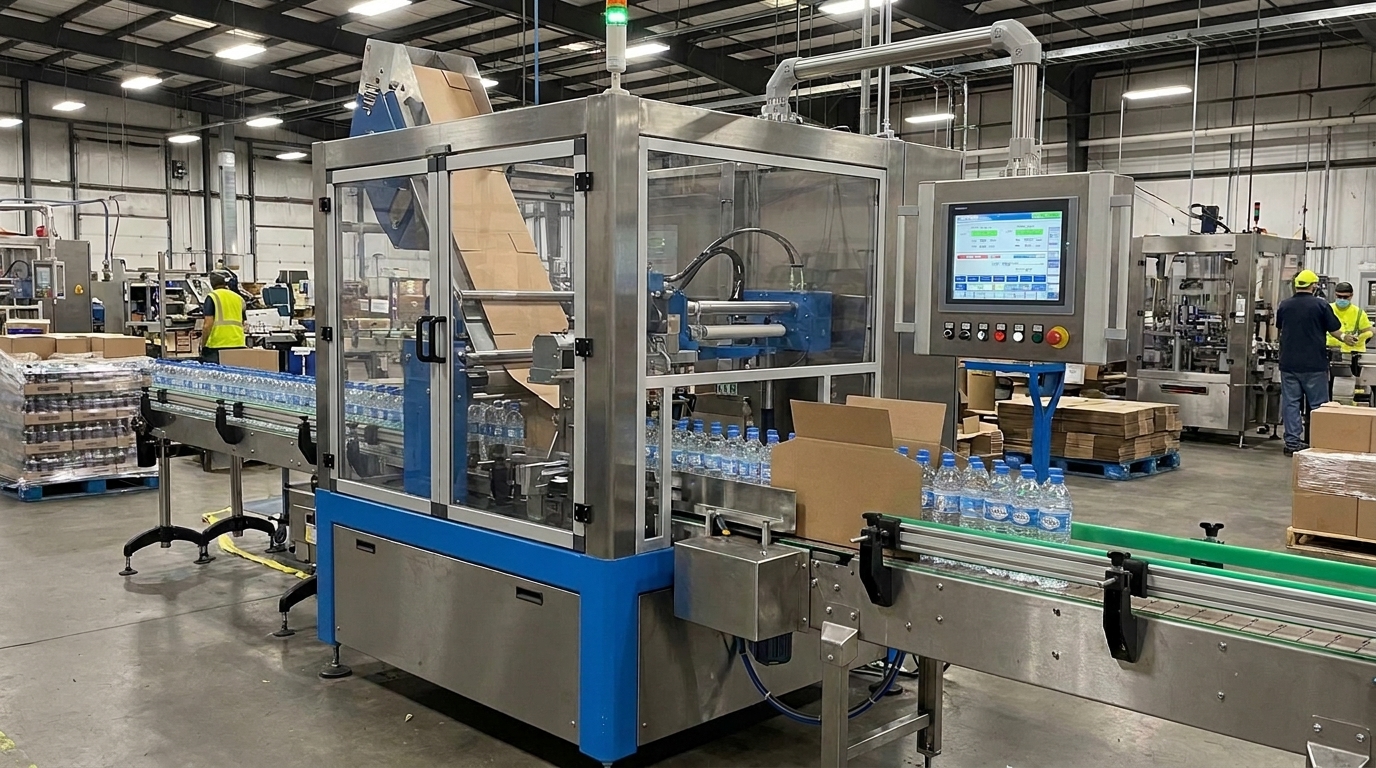
Case formation plays a critical role in secondary packaging. The corrugated blank must fold accurately around the product group, maintain the intended shape, and reach the closing section in the correct position. Small problems during this stage may affect case quality and create interruptions further down the packaging line.
A wrap around case packer relies on coordinated feeding, folding, product positioning, and case handling to form each package correctly. Issues with board quality, product alignment, machine settings, or mechanical components may prevent the case from forming as intended and lead to unstable or poorly closed packages.
Why Proper Case Formation Matters
A properly formed case protects the products during handling and transportation. It also provides a consistent shape for downstream equipment such as case conveyors, palletizers, and wrapping systems.
Poor formation may cause open flaps, uneven corners, distorted cases, or weak closures. These problems can affect both packaging appearance and line performance.
Common Problems During Case Formation
Several issues can interfere with reliable case formation. Identifying the source helps operators make targeted adjustments instead of repeatedly changing unrelated machine settings.
Incorrect Product Positioning
The product group must enter the forming area in the correct position. Products that shift or arrive with inconsistent spacing may cause the corrugated blank to fold around them incorrectly.
Misalignment can also create pressure on the board during folding. Operators should check product guides, timing, grouping mechanisms, and conveyor movement when this problem occurs.
Poor Corrugated Board Quality
The condition of the corrugated material has a direct effect on case formation. Warped, damaged, damp, or inconsistent blanks may not travel or fold properly.
Board thickness and stiffness also influence folding performance. Packaging material should match the machine’s specifications and the requirements of the finished case.
Incorrect Folding Settings
Folding mechanisms need accurate positioning to create clean and consistent bends. Incorrect settings may leave flaps partially folded or cause the board to fold at the wrong point.
Operators should check folding guides, belts, rails, and other forming components when cases repeatedly show the same folding defect.
Misaligned Case Blanks
The blank needs to enter the forming section in a consistent position. A blank that shifts sideways or enters at an incorrect angle may produce an uneven case.
Blank guides and feeding components should maintain consistent movement throughout the forming process. Wear or incorrect adjustment can gradually affect alignment.
Product Grouping Problems
Case formation depends heavily on the arrangement of products inside the package. An incorrect product count or uneven grouping can change the pressure applied to the corrugated material.
Products that sit too close to one side may produce an uneven case. Loose grouping can create gaps, while excessive pressure may interfere with folding.
Regular inspection of the product infeed can help identify grouping problems before they reach the case-forming section.
Problems With Glue or Sealing
Some wrap around case designs use adhesive during the closing process. Although adhesive application occurs later than initial folding, problems with glue quantity, placement, temperature, or timing can affect the final case structure.
Insufficient adhesive may result in weak closures. Excess adhesive can create contamination or interfere with downstream handling.
Operators should follow the equipment and adhesive supplier’s specifications when troubleshooting sealing issues.
Conveyor Timing and Speed Issues
Case formation requires synchronized movement between the product group, corrugated blank, and forming mechanisms. Incorrect timing can cause the blank to reach the forming area too early or too late.
Conveyor speed also matters. Excessive speed may reduce positioning accuracy, while insufficient speed can affect production efficiency.
Control settings, sensors, and drive components should all receive attention when timing problems appear repeatedly.
Worn or Damaged Machine Components
Mechanical wear can gradually reduce forming accuracy. Belts, guides, rollers, folding components, and other contact surfaces may lose their intended position or condition after extended operation.
Routine inspections can help detect wear before it causes frequent production problems. Replacing worn components according to maintenance recommendations may restore consistent case movement.
Techflow Pack emphasizes equipment configuration and operating requirements when developing packaging solutions. Proper maintenance also helps packaging equipment maintain reliable performance during regular production.
Sensor and Control Problems
Sensors help the machine detect product position, case blanks, and machine conditions. A dirty, damaged, or incorrectly positioned sensor may send inaccurate signals to the control system.
These problems can produce inconsistent timing or unexpected machine stops. Operators should inspect sensor alignment and cleanliness before making major mechanical adjustments.
The control system should also receive appropriate diagnostic attention when sensor signals appear normal but the machine continues to behave unexpectedly.
How Operators Can Troubleshoot Case Formation
A systematic approach usually works better than changing several settings at once. Operators can begin by identifying the exact point where the case starts to deviate from the intended formation.
A practical troubleshooting sequence includes:
- Inspect the corrugated blanks for damage or warping.
- Check product count and product alignment.
- Examine blank feeding and guide positioning.
- Verify folding and forming adjustments.
- Check conveyor timing and machine speed.
- Inspect sensors for alignment or contamination.
- Look for worn or damaged mechanical components.
- Test the machine after making one adjustment at a time.
This process makes it easier to identify the underlying cause and avoid unnecessary changes.
Preventing Case Formation Problems
Preventive maintenance and consistent operating procedures can reduce many common formation issues. Operators should monitor board quality, machine adjustments, product positioning, and component condition as part of routine production checks.
It also helps to document recurring problems. A record of machine settings, product formats, material specifications, and corrective actions can make future troubleshooting faster.
Training operators to recognize early signs of poor case formation can further reduce extended interruptions.
When to Review the Machine Configuration
Recurring formation problems may indicate that the machine configuration does not fully match the application. Frequent product changes, new case dimensions, or different corrugated materials can introduce requirements that the original setup did not address.
Manufacturers should review the complete application when adjustments no longer provide consistent results. The review may include product dimensions, case design, material specifications, production speed, and changeover requirements.
Final Thoughts
Case formation problems may result from several factors, including product alignment, corrugated board quality, blank positioning, folding adjustments, conveyor timing, sensors, and mechanical wear.
A structured troubleshooting process can help operators locate the source without making unnecessary changes. Techflow Pack provides case packing solutions designed around specific product and packaging requirements, helping manufacturers evaluate equipment configurations that support consistent case formation.