


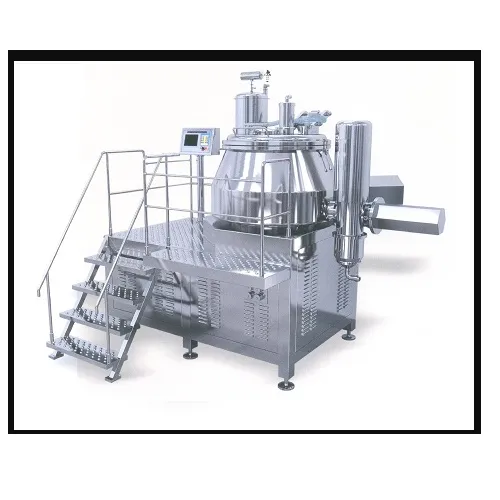
Many industrial processes require powders and fine particles to be converted into more manageable granules. Granulation can improve material flow, reduce dust, control particle size, and make subsequent handling or processing easier. Achieving consistent granules depends on controlling both the mixing and liquid-addition stages.
A Granulator Mixer combines intensive material movement with controlled addition of liquids, binders, or other components to encourage particles to form larger agglomerates. The equipment can perform mixing and granulation within the same processing chamber, depending on the machine configuration and material requirements.
What Is a Granulator Mixer?
A granulator mixer is industrial equipment designed to blend materials while promoting controlled particle agglomeration.
The process generally involves mixing dry powders or granular materials before introducing a liquid or binder. Mechanical movement distributes the liquid across the particles and encourages them to adhere to one another.
The resulting granules can then be discharged for drying, screening, compaction, or further processing.
How Does a Granulator Mixer Work?
The granulation process normally begins with loading the raw materials into the mixing chamber.
The mixing tools create intensive circulation, moving particles through different areas of the chamber. A liquid binder, water, or another processing agent can then be introduced at a controlled rate.
As the liquid contacts the particles, small agglomerates begin to form. Continued mechanical movement helps distribute the binder and develop the desired granule structure.
The process is stopped when the required particle characteristics are reached.
Main Stages of the Granulation Process
Dry Mixing
The initial stage distributes the raw powders and other dry ingredients throughout the mixing chamber.
Achieving a relatively uniform dry blend before liquid addition can help improve the consistency of subsequent granulation.
Liquid Addition
Liquid is introduced gradually according to the formulation and desired granule properties.
The addition rate must be controlled carefully because too little liquid may result in weak agglomeration, while excessive liquid can produce overly large or sticky granules.
Agglomeration
Mechanical forces and liquid bridges cause individual particles to combine into larger agglomerates.
The intensity and duration of mixing influence the size and structure of the resulting granules.
Final Conditioning
Additional mixing may be used to stabilize the granules and achieve the required distribution before discharge.
Key Features of Granulator Mixers
Intensive Mixing Action
Strong mechanical movement helps distribute powders and liquids throughout the batch.
This can support more consistent binder coverage and granule formation.
Controlled Liquid Addition
Accurate liquid dosing is essential for controlling the granulation process.
A suitable system should allow operators to adjust the quantity and addition rate according to the formulation.
Adjustable Processing Parameters
Mixing speed and processing time can influence granule size, density, and uniformity.
The appropriate parameters depend on the material and desired product characteristics.
Integrated Mixing and Granulation
Combining mixing and granulation in one processing stage can reduce material transfers and simplify the production process.
Applications of Granulator Mixers
Granulation technology is used in many industries where powder handling and particle-size control are important.
Typical applications include:
- Fertilizer production
- Mineral processing
- Ceramic materials
- Refractory materials
- Chemical products
- Construction materials
- Foundry materials
- Powder conditioning
The appropriate mixer configuration depends on the properties of the raw materials and the required granule specifications.
Granulation of Refractory Materials
Some refractory manufacturing processes require controlled granulation or conditioning of fine materials.
A mixer can combine refractory powders with binders or moisture to produce a more manageable material for subsequent processing.
Particle size and moisture control are particularly important because they can influence packing and forming characteristics.
Mineral Processing
Mineral powders can be difficult to transport or feed because of their fine particle size.
Granulation can improve flow characteristics and reduce airborne dust.
The mixer must provide sufficient mechanical action while avoiding excessive agglomeration.
Construction Materials
Some cement-based and mineral construction products can benefit from controlled granulation.
Mixing equipment can distribute moisture or binders through dry components before the material moves to the next processing stage.
The desired granule properties depend on the final application.
Factors That Affect Granulation Quality
Granulation results depend on several interacting variables.
Moisture Content
Liquid quantity has a major influence on agglomeration. The correct moisture level depends on the material and binder system.
Liquid Addition Rate
Adding liquid too quickly can create wet areas and large agglomerates.
Gradual and controlled addition generally provides better process control.
Mixing Speed
Higher mechanical intensity can increase particle interaction and influence agglomerate formation.
However, excessive speed may break apart newly formed granules.
Processing Time
The granulation cycle needs to be long enough for the desired particle structure to develop.
Over-processing can change granule size and increase energy consumption.
Material Properties
Particle size, surface characteristics, density, moisture absorption, and cohesiveness all affect granulation behavior.
Choosing the Right Granulator Mixer
Equipment selection should begin with the intended material and final granule specifications.
Important factors include:
- Raw material composition
- Particle size
- Bulk density
- Moisture content
- Binder type
- Required granule size
- Batch capacity
- Production rate
- Mixing intensity
- Discharge requirements
Testing representative materials can help determine suitable operating conditions.
Consider Mixer Capacity
The working capacity should provide enough space for effective particle circulation.
Overloading the mixing chamber may restrict material movement and reduce granulation consistency.
At the same time, an oversized machine may not provide optimal processing when operating with very small batches.
Evaluate Mixing Tools
Tool geometry influences material circulation and mechanical forces.
The tools should be suitable for the material’s abrasiveness and the desired granulation mechanism.
For demanding applications, wear-resistant construction can help extend service life.
Liquid and Binder Systems
The liquid addition system should deliver the required quantity consistently.
Depending on the process, the system may need to distribute water, chemical binders, oils, or other liquids across the mixing zone.
Uniform liquid distribution is important for producing consistent agglomerates.
Maintenance Considerations
Granulation can expose internal mixer components to abrasive and sticky materials.
Mixing tools, liners, seals, shafts, and other components should be inspected regularly.
Cleaning is also important because accumulated material can affect subsequent batches and change the intended mixing conditions.
Automation and Process Control
Automation can improve granulation repeatability by controlling material quantities, liquid dosage, mixing speed, processing time, and discharge.
For industrial production, the mixer may be integrated with weighing systems, feeders, conveyors, drying equipment, and screening systems.
Process data can also help operators identify variations and optimize production parameters.
Energy Efficiency
Granulation requires mechanical energy, particularly when intensive mixing is involved.
Efficient operation depends on using suitable mixing intensity and avoiding unnecessarily long processing cycles.
Energy consumption should be evaluated alongside production rate and granule quality.
Importance of Testing
Granulation behavior can vary significantly between materials. Laboratory or pilot testing can help determine how the formulation responds to different mixing conditions.
Testing can establish:
- Suitable liquid dosage
- Liquid addition rate
- Mixing speed
- Processing time
- Granule size
- Material yield
- Discharge behavior
These results can help guide full-scale equipment selection and process development.
Conclusion
A granulator mixer combines intensive mixing with controlled agglomeration to transform powders or fine particles into more manageable granules. Its performance depends on material properties, liquid dosage, mixing intensity, processing time, and equipment configuration.
Granulation equipment can be applied to refractory materials, minerals, construction products, ceramics, chemicals, fertilizers, and other industrial materials. By selecting suitable capacity, mixing tools, liquid-addition systems, automation, and wear-resistant components, manufacturers can establish a more consistent and efficient granulation process.