


For furniture manufacturers, construction firms, and building material wholesalers, every procurement decision carries weight. One question increasingly dominates purchasing meetings: is particle board the right strategic choice for our production needs? The answer, for many B2B buyers in 2026, is becoming clear.
China’s particle board exports surged 113.4% year-over-year in early 2026, signaling a fundamental shift in global procurement patterns. This growth reflects a strategic recalibration among B2B procurement professionals who are prioritizing cost predictability, supply chain resilience, and regulatory compliance in their material sourcing strategies.
This article examines why Particle Board supplier selection has become a strategic priority, and how procurement leaders can make informed decisions when evaluating particle board as a core material for their production lines.
What’s Driving the Growing Demand for Particle Board in B2B Sourcing?
Three converging forces are reshaping B2B material procurement decisions in 2026, making particle board an increasingly attractive option for volume buyers.
First, production scale has reached unprecedented levels. The global particle board market is projected to reach $26.39 billion by 2031, with major manufacturing clusters in China, Europe, and Southeast Asia operating at massive scale. This scale drives consistency, reduces unit costs, and enables reliable supply for large-volume contracts.
Second, environmental regulations are tightening globally. The new Chinese national standard GB 18580-2025, effective June 2026, mandates E0 grade (≤0.050mg/m³) as the minimum market access threshold for finished furniture products. This regulatory pressure is accelerating capacity consolidation. Compliant Particle Board factory operations with upgraded low-emission adhesive systems are gaining market share, while less capable producers are being phased out — making it easier for buyers to identify quality Particle Board supplier partners.
Third, application versatility continues to expand. Modern particle board products are available in multiple grades — from standard interior panels to moisture-resistant (HMR) and high-density variants — each engineered for specific manufacturing requirements. For B2B buyers managing diverse product lines, this versatility simplifies procurement by allowing consolidation of material sourcing across multiple applications.
What Cost Advantages Does Particle Board Offer for Volume Production?
For procurement professionals managing large-scale manufacturing, the cost structure of particle board delivers distinct advantages.
| Cost Factor | Particle Board Advantage |
| Raw Material Sourcing | Utilizes wood chips, sawmill residues, and recycled fibers — abundant, locally sourced, and price-stable |
| Production Consistency | Standardized process ensures uniform density and thickness across batches, reducing downstream processing waste |
| Processing Efficiency | Predictable dimensions minimize machining adjustments and material loss during cutting and edging |
| Logistics Optimization | Standard panel sizes maximize container utilization, reducing per-unit shipping costs |
| Certification Economics | Scale production distributes compliance costs efficiently across large volumes |
For high-volume furniture Particle Board users like kitchen cabinet manufacturers, RTA furniture producers, and office systems suppliers, these cost drivers translate directly into improved gross margins. The key is partnering with a wholesale Particle Board supplier that offers factory-direct pricing and consistent quality across large orders.
Procurement Insight: When calculating total landed cost, evaluate not just the material price but also processing yield, scrap rates, and logistics efficiency. A slightly higher-priced board with superior consistency often delivers lower total production cost than a cheaper alternative with greater dimensional variation.
What Quality Indicators Should B2B Buyers Verify When Sourcing Particle Board?
When evaluating Particle Board supplier capabilities, procurement professionals should prioritize these verification points to ensure consistent quality across orders.
1. Production Scale and Process Control
Ask about annual capacity, number of production lines, and hot-press technology. Consistent thickness tolerance within ±0.3mm indicates advanced equipment and precise process control — essential for automated production lines.
2. Raw Material Sourcing and Traceability
Verify the source of wood chips and fibers. A factory direct Particle Board supplier with integrated supply chains — from residual wood collection to finished panels — offers greater traceability and quality assurance. This transparency helps buyers confirm the absence of contaminated or non-compliant materials.
3. In-House Testing Capability
A reliable certified Particle Board supplier maintains an on-site laboratory for routine testing of density, moisture content, internal bond strength, and formaldehyde emission. Batch test records should be available for customer review upon request.
4. Environmental and Quality Certifications
Look for FSC, CE, CARB P2, and ISO9001 certifications. These demonstrate compliance with major market requirements and ongoing third-party auditing. For manufacturers exporting to regulated markets, certified suppliers reduce customs clearance risk.
5. Export Experience and Logistics Capability
Suppliers with established logistics networks and experience shipping to multiple international markets understand packaging standards, documentation requirements, and delivery expectations — reducing the administrative burden on the buyer’s procurement team.
Which Particle Board Variants Should B2B Buyers Consider for Different Applications?
Understanding particle board product grades is essential for matching material specifications to manufacturing requirements. Modern Particle Board panels are available in several variants:
| Variant | Key Characteristics | Recommended Applications |
| Standard Particle Board | Balanced density, cost-optimized | Interior furniture, shelving, cabinetry |
| Moisture-Resistant (HMR) | Thickness swelling ≤6% (vs. ≤8% standard) | Kitchen cabinets, bathroom vanities |
| High-Density Particle Board | Enhanced strength and screw-holding | Work surfaces, industrial shelving |
| Melamine Particle Board | Pre-laminated surface, ready for assembly | RTA furniture, office systems, retail displays |
| Low-Emission Particle Board | E0/CARB P2 compliant | Projects requiring strict indoor air quality |
For B2B buyers managing multiple product lines, working with an OEM Particle Board manufacturer offers additional advantages: custom thicknesses, tailored densities, private-label packaging, and dedicated production runs. These capabilities are particularly valuable for furniture brands and distributors building proprietary product lines with consistent material specifications.
What Supply Chain Risks Should Procurement Professionals Anticipate?
Building a resilient supply chain requires anticipating potential disruptions and qualifying multiple sourcing options.
Concentration risk is the primary concern — when a buyer relies on a single factory or geographic region, any production disruption (equipment failure, raw material shortage, or policy change) can halt deliveries. Mitigating this requires:
- Qualifying backup suppliers: Identify and audit at least two additional Particle Board factory options that meet your quality specifications
- Building strategic inventory: Maintain safety stock of critical SKUs to buffer against short-term supply interruptions
- Establishing communication protocols: Ensure suppliers provide proactive notification of potential delays
Quality consistency risk also warrants attention — even within the same factory, variations in raw material batches can affect board properties. Mitigation includes:
- Requiring batch-specific test reports: Verify each shipment meets your agreed specifications
- Implementing incoming inspection: Test critical parameters (density, thickness, moisture content) upon receipt
- Establishing performance feedback loops: Share downstream processing results with suppliers to enable continuous improvement
How Does a Qualified Particle Board Supplier Support Procurement Efficiency?
Shandong Fortuna International Trade Co., Ltd. (Fortuna) , established in the 1990s and headquartered in Linyi, China, operates a 208,000 m² manufacturing facility with annual output exceeding 300,000 m³ of particle board, MDF, and other engineered wood products. The company holds FSC, CE, CARB P2, and ISO9001 certifications and serves customers across more than 170 countries and regions, including Canada, the United States, Belgium, Denmark, and beyond.
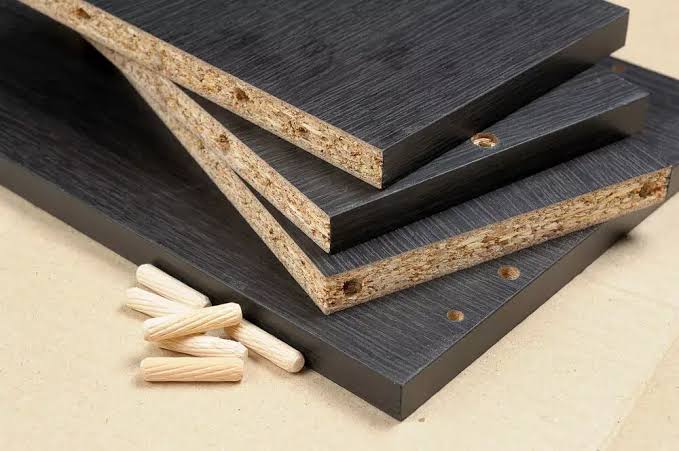
Fortunaply’s particle board products feature a three-layer graded structure – fine particles on the surface for smooth lamination, coarse particles in the core for structural strength. This design optimizes both surface finish and internal bond strength, critical for melamine Particle Board applications where decorative surfaces must adhere perfectly without telegraphing substrate imperfections.
The company supports OEM customization including thickness, density, size, and packaging, with full-process quality control from raw material screening through final inspection. Its export logistics team manages container loading, shipping documentation, and delivery timelines, reducing procurement complexity for international buyers. As a vertically integrated Particle Board manufacturer with both factory and trading capabilities, Fortuna provides direct technical support and consistent quality across repeat orders — a significant advantage for procurement teams seeking to reduce supplier management overhead.
Conclusion
The growing adoption of particle board in B2B manufacturing reflects its compelling value proposition: cost predictability, supply reliability, and application versatility. For buyers managing large-scale furniture, cabinetry, or building material programs, selecting the right Particle Board supplier is a strategic decision that impacts production efficiency, product quality, and overall competitiveness.
For standardized, volume-driven production, particle board offers distinct procurement advantages when sourced from qualified manufacturers with proven quality systems, international certifications, and export expertise.
Next Step for Procurement Professionals: Request material specifications and post-June 2026 GB 18580-2025 compliance test reports from shortlisted suppliers. Conduct virtual or in-person factory audits focusing on hot-press precision, quality control workflows, and raw material traceability. A disciplined selection process ensures your wholesale Particle Board sourcing delivers both immediate cost savings and long-term supply chain resilience.